If you work in education across Africa, you already know the scramble. Every NGO, every social enterprise, every community school project — all chasing the same shortlist of funders. USAID. Gates Foundation. Open Society. The proposals pile up. The competition is brutal. And most of the time, the answer is no.
But here is something that often goes unsaid: the funding landscape for education in Africa is far wider than that shortlist. There are foundations — some Dutch, some Swiss, some Gulf-based, some Australian — that are actively grantmaking across Sub-Saharan Africa with far less competition at the door. They are not secret. They are simply overlooked.
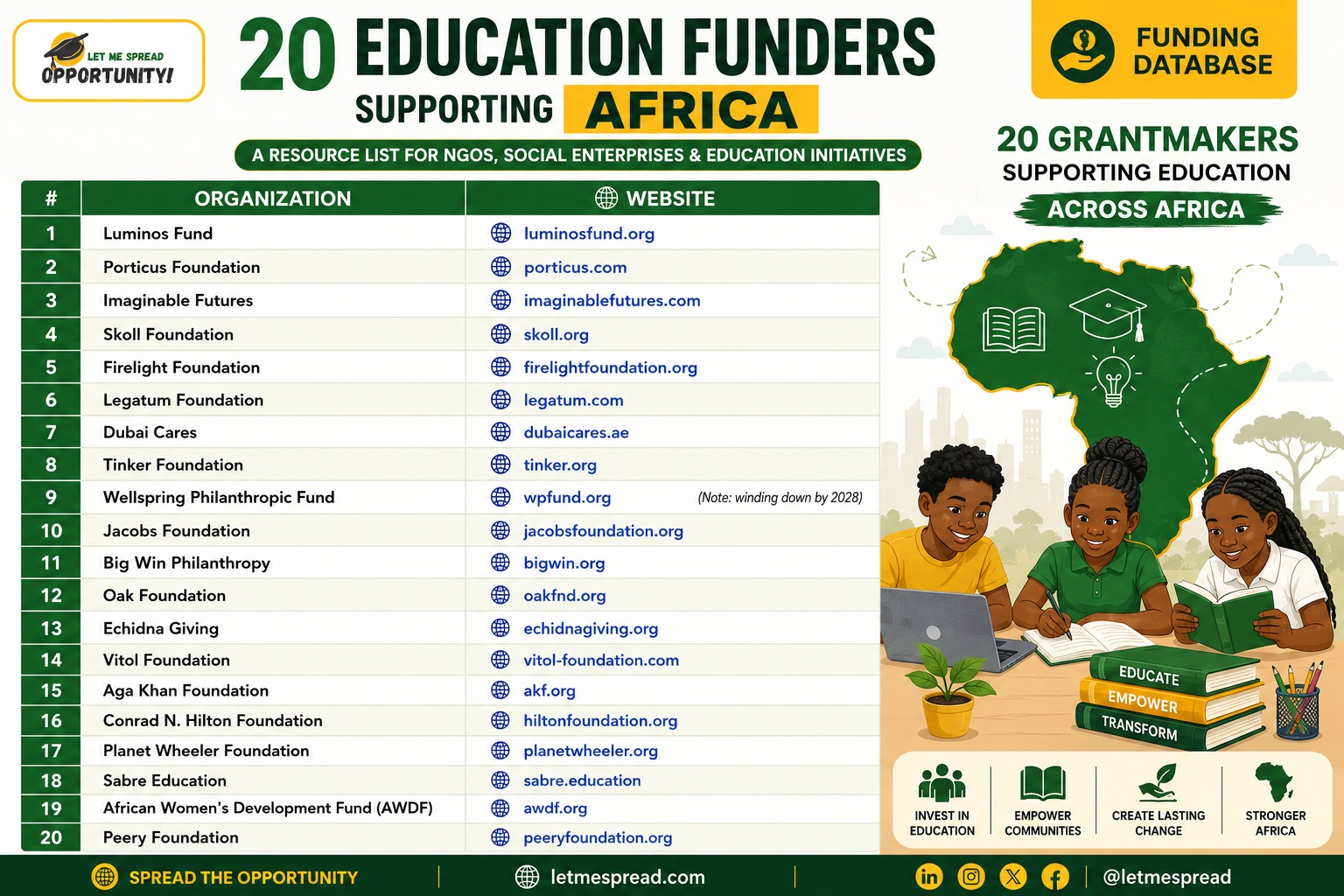
This list is an attempt to change that. Below are 20 funders — ranging from established foundations with dedicated Africa education windows to newer philanthropic vehicles — that most NGOs have not yet knocked on the door of. Some focus specifically on girls' education. Some fund community-led organizations. Some are looking for social entrepreneurs. A few are genuinely niche.
The best funding opportunity is not the most famous one — it's the one your competitors haven't found yet.
Read through the full list. Note what aligns with your focus, your geography, and your model. Then do the research before applying — understanding a funder's theory of change before you write a single word of a proposal is the difference between a competitive application and a rejected one.
The 20 Funders
Luminos Fund works specifically with out-of-school children who have missed their window for formal education. Their accelerated learning model — currently active in Ethiopia, Ghana, Liberia, and Gambia — brings children up to grade level in a single year. For NGOs working in foundational literacy and numeracy with marginalized children, this is one of the most relevant funders on the continent. They are not a generalist funder; they want partners who share their focus on second-chance education.
luminosfund.org →Porticus is a Dutch Catholic foundation with a genuinely global reach, and their Sub-Saharan Africa education portfolio is substantial. Their focus is inclusive education — meaning they fund programs that serve children with disabilities, children from marginalized communities, and those excluded from mainstream schooling. They are values-driven in the Catholic social tradition, which means human dignity, solidarity, and community are themes that resonate in their applications. They are underutilized by smaller NGOs, partly because they are not widely advertised.
porticus.com →Backed by the Omidyar Network, Imaginable Futures invests in learning innovations that can shift systems, not just serve individuals. Across Africa, they are interested in EdTech, teacher development, and models that have the potential to influence policy or reach scale. If you are building something with a strong learning outcomes story and a credible pathway to impact beyond your immediate cohort, this is a funder worth studying closely. They lean toward organizations that can articulate what they are learning, not just what they are doing.
imaginablefutures.com →The Skoll Foundation funds social entrepreneurs — people who have built or are building organizations designed to solve structural problems. In education, they look for leaders tackling access, quality, and equity at a level that creates genuine systemic change. This is not a grant for a good community project. Skoll is looking for the next Teach For All, the next Bridge, the next model with a story to tell at the World Economic Forum. If that sounds like you, apply. If you are earlier stage, build the track record first.
skoll.org →Firelight Foundation is one of the rare funders that has built its entire strategy around community-based organizations — the grassroots groups that are closest to the children they serve but least likely to receive international funding. They work exclusively in Sub-Saharan Africa and deliberately partner with small, locally-led organizations. If you are a community-based NGO struggling to get in the door with larger institutional funders, Firelight is specifically designed for organizations like yours. Their grants tend to be modest but accompanied by genuine capacity-building support.
firelightfoundation.org →Legatum funds transformative education models with a clear lens on economic mobility — they want to see how education connects to long-term livelihood outcomes. Across Africa, they are interested in programs that measurably improve life trajectories, not just enrollment rates or test scores. If your program has a strong story about what happens to young people five or ten years after they go through it, that is the narrative Legatum wants to hear. They are less visible than many funders their size, which means the room is less crowded.
legatum.com →Dubai Cares is a UAE-based philanthropic organization with a serious education portfolio in Africa — one that most non-Gulf NGOs have never engaged with. They have funded programs in both East and West Africa, with a focus on access to quality education for children in challenging circumstances. If your organization has never thought to look toward the Gulf for education funding, this is the funder to start with. They bring both resources and a genuinely underutilized relationship from the perspective of most African NGOs.
dubaicares.ae →The Tinker Foundation has a relatively focused mandate — education and civic engagement in developing country contexts — which means they do not fund everything everywhere, but where they do fund, they go deep. For NGOs whose education work has a civic dimension — youth leadership, democratic participation, informed citizenship — Tinker is worth exploring. They are niche, which is actually an advantage: fewer organizations know to apply, and the ones that do tend to fit their frame well.
tinker.org →Wellspring has been a significant funder of education equity and girls' education globally, and their Africa grantmaking has been active and meaningful. The critical piece of information here is that Wellspring is winding down its operations by 2028. This is not a reason to skip them — it is a reason to move quickly. A funder that is winding down still has money to deploy and is often looking for strong partners to steward their final grants. If your work aligns with education equity or girls' education, apply now rather than later.
wpfund.org → ⚠ Winding down operations by 2028 — apply sooner rather than later.
Switzerland-based Jacobs Foundation focuses on youth learning and development with a research-informed approach. They fund programs that improve learning outcomes for young people, and they have active grantees in Africa. What distinguishes Jacobs is their interest in the science of learning — they want to know not just that your program works, but why it works and what you are measuring. Organizations with strong monitoring, evaluation, and learning frameworks will fare better here than those with anecdotal evidence alone.
jacobsfoundation.org →Big Win Philanthropy takes a concentrated approach — they focus on a small number of high-impact African countries and go deep on adolescent development and learning outcomes. Their work sits at the intersection of education, health, and economic opportunity for young people. If your program serves adolescents and you can demonstrate impact on their learning trajectories or life outcomes, Big Win is a funder whose geographic and thematic focus may align well with your work. They are not widely known outside the specialist education funding community.
bigwin.org →Oak Foundation funds education for vulnerable children — children in conflict zones, children living in poverty, children who have experienced trauma or displacement. Across Africa, they have supported programs focused on learning access for children who fall outside the reach of mainstream education systems. They are a substantial funder that many smaller NGOs have overlooked simply because Oak's name does not appear in the same conversations as Gates or USAID. Their children's education portfolio is active and genuinely open to strong proposals from the ground.
oakfnd.org →Echidna Giving is single-minded in the best possible way: they fund girls' education, and nothing else. Globally focused, with active grantmaking across Africa, Echidna specifically supports programs that improve educational access, quality, and completion for girls. If girls' education is the center of your work — not a component, but the core — then Echidna is one of the most targeted funders you will find. They are not yet as prominent as some of the larger girls' education funders, which means the competition is more manageable.
echidnagiving.org →The Vitol Foundation is connected to Vitol Group, one of the world's largest energy trading companies, and their philanthropic arm has channeled significant funding into education across East and West Africa. They tend to fund vocational education, skills development, and programs that connect young people to economic opportunity. For NGOs working at the intersection of education and livelihood — particularly in communities affected by the energy sector — Vitol Foundation is an underexplored entry point. Corporate foundation funding can sometimes move faster and with fewer bureaucratic layers than traditional philanthropy.
vitol-foundation.com →This one might surprise you — the Aga Khan Foundation is not a secret. But it is chronically underutilized by smaller and mid-size NGOs, who assume it is only accessible to large, established organizations. In reality, AKF has significant education funding windows across East Africa and is genuinely interested in community-rooted programs with strong local leadership. The key is understanding how they think: AKF is not just a funder, they are a development institution with a long view. Organizations that demonstrate alignment with their approach to pluralism and local ownership tend to do well.
akf.org →The Conrad N. Hilton Foundation has made early childhood development and education a major pillar of their Africa work, particularly in East Africa. They are interested in integrated approaches — programs that combine nutrition, health, and early learning — and in systems that can reach children in their earliest years before formal schooling begins. For organizations working in ECD, pre-primary, or programs that support caregivers and parents as the child's first educators, Hilton Foundation is a significant funder that does not always appear on the shortlists circulating in the sector.
hiltonfoundation.org →Planet Wheeler is an Australian foundation with a deliberately niche approach — they fund education programs in underserved African communities that larger funders tend to overlook. Founded by the co-founder of Lonely Planet, there is a spirit of adventure and discovery in how they approach grantmaking. They are small, which means they fund selectively, but they are also genuinely mission-driven rather than process-driven. If you are working in a community or context that feels off the international funding radar, Planet Wheeler may be exactly the right door to knock on first.
planetwheeler.org →Sabre Education is a Ghana-based specialist education NGO rather than a traditional foundation, and that distinction matters. They are not primarily a grant-maker — they are a doing organization. But they represent a valuable opportunity for co-funding and partnership that many organizations miss. If you are working in Ghana or West Africa and want to approach international funders with a stronger base, partnering with Sabre can give your proposal credibility, local grounding, and connections. Think of them less as a funder and more as a strategic entry point into the ecosystem.
sabre.education →AWDF is one of the most important funders on this list — and one of the most underutilized by organizations that do not self-identify as women's organizations. Their education portfolio spans girls' education and women's literacy, and critically, they specifically fund programs that are led by African organizations. This is not an outsider funding Africa; this is Africa funding Africa. If your organization is African-led and your work touches on girls' education or women's literacy in any meaningful way, AWDF should be near the top of your funding list, not buried at the bottom.
awdf.org →Peery Foundation is a Utah-based foundation focused on economic mobility through education, with select African grantees in their portfolio. They are small enough that every grant they make represents a genuine relationship rather than a portfolio entry, and they are specifically interested in programs that connect educational outcomes to long-term economic change. If you can show that your program does not just educate young people but changes where they end up economically — whether through vocational training, entrepreneurship, or access to formal employment — Peery Foundation is worth a conversation.
peeryfoundation.org →Final Thoughts
Twenty funders. Most of them rarely mentioned in the proposal-writing workshops or the funding directories that circulate in the sector. None of them impossible to reach.
The honest truth about funding diversification is that it takes time — time to research, time to build relationships, and time to write proposals that are genuinely tailored rather than copy-pasted. But the organizations that invest that time are the ones that are less vulnerable to the one phone call that changes everything: the call where a major funder tells you they are shifting priorities.
Start with three funders from this list whose focus genuinely aligns with your work. Read everything on their website. Find their annual reports. Look up their grantees and understand what those organizations have in common. Then write a proposal that sounds like you have done that research — because you have.
The door is less crowded than you think. Go knock on it.